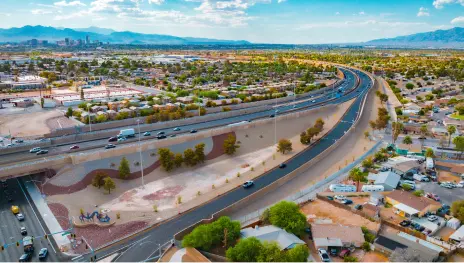
Building on a decade of progress, and confronting the next decade of demand and innovation

In April 2016, the Regional Transportation Commission of Southern Nevada (RTC) published the Transportation Investment Business Plan (TIBP 1.0), a first-of-its-kind blueprint that approached mobility not as a public works checklist but as a business case for the future of Southern Nevada’s economy. The plan tied transportation investment directly to the visitor experience, the resort industry, and the region’s capacity to compete globally.

Nearly a decade later, the case for that approach is stronger than ever.
Looking Ahead to 2050+

A stronger region. A better quality of life.

TIBP 2.0 focuses on transportation investments that improve mobility, support economic growth, reduce congestion, and create more reliable ways for people to move throughout Southern Nevada.

2.9M+

Residents by 2050

Our region is growing fast.

34%

Population increase

More people. More places to go.

35%+

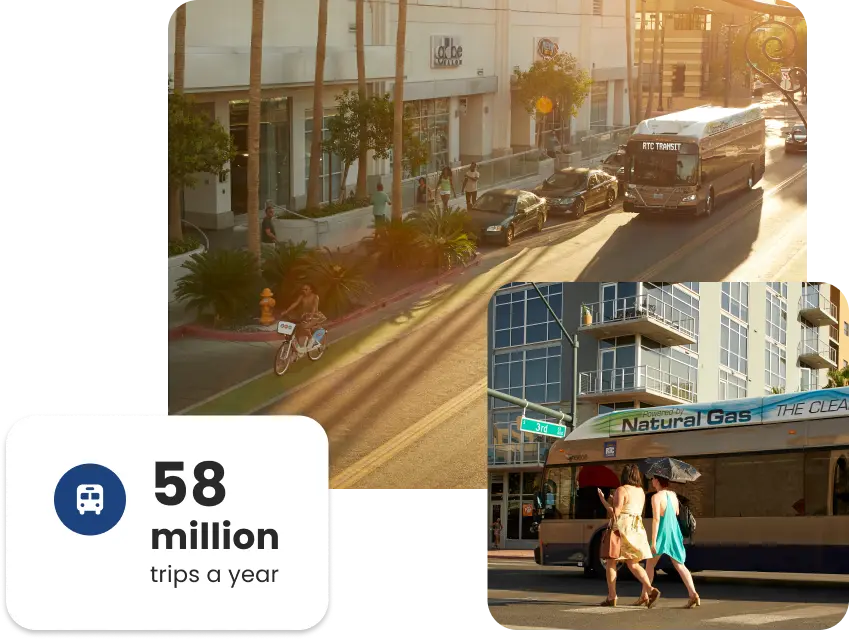
Transit ridership growth

More riders. More connections.

How the community has changed

When TIBP 1.0 was drafted, the venue map of the Resort Corridor was meaningfully different. In roughly ten years, the region added the following:

Allegiant Stadium
2020

Number of Seats: 65,000
Home to the Raiders and UNLV football, it has hosted Super Bowl LVIII and is scheduled to host Super Bowl LXIII in 2029. It has become the highest-grossing stadium in the United States while fundamentally reshaping Resort Corridor traffic on event days.

Resorts World Las Vegas
2021

Number of Seats: 3,500
The first ground-up integrated resort on the Strip in more than a decade, adding rooms, an arena-scale theater, and convention space at the corridor’s north end.

Fontainebleau Las Vegas
2023

Number of Seats: 3,800
A $3.7 billion luxury resort and the tallest occupied building in Nevada, adding rooms, convention space and a 3,800-seat theater at the corridor’s north end.

The Sphere
2023

Number of Seats: 17,500
A new venue type whose programming, location east of the Strip, and rideshare/transit demand profile were not contemplated in any 2016-era plan.

Formula 1 Las Vegas Grand Prix
Annually since 2023

Number of Spectators: ~315,000
It closed Las Vegas Boulevard and adjacent streets for several days each November and was a use case that TIBP’s scenarios did not address.

Hard Rock Las Vegas
Under Construction

Number of Seats: ~3,600
A guitar-tower redevelopment of the former Mirage at the center of the Strip, scheduled to open in 2027 with expanded gaming, convention, and entertainment space.

Las Vegas A’s Stadium
Under Construction

Number of Seats: 33,000
Major League Baseball’s arrival adds an 81-home-game venue adjacent to Allegiant Stadium and the I-15 corridor.

Why now is the right time for TIBP 2.0

Five different conditions make this the perfect time to refresh the plan.
1

Demand has outrun the 2016 forecast

The RTC’s 2026 Resort Corridor Capacity Study finds 26 percent of Resort Corridor roadways already operating over capacity, rising to 34 percent by 2030 and 41 percent by 2035 under baseline conditions. In modeled 2035 extra-large concurrent-event scenarios, travel time on Las Vegas Boulevard from Sahara Avenue to Russell Road stretches from 14 minutes in free flow to 24 to 30 minutes over the roughly 4-mile distance. Left unaddressed, this congestion becomes an economic risk in its own right: constrained mobility limits visitor throughput, erodes the visitor experience, and can stifle the continued economic growth Southern Nevada depends on.

2

Southern Nevada has diversified, but remains uniquely dependent on the tourism sector

The region has added employers across logistics, healthcare, technology, sports, and manufacturing. Even so, Southern Nevada hosted roughly 38.5 million visitors in 2025 against a metro population of approximately 2.3 million, resulting in a visitor-to-resident ratio of nearly 17 to 1. Additionally, the industry currently accounts for roughly 49 percent of the region’s gross regional product and the preponderant share of jobs, wages and salaries, and local tax collections. No peer metro carries comparable exposure to mobility outcomes.

3

The venue and event calendars have fundamentally changed

As detailed above, TIBP 1.0’s scenarios did not, and could not, contemplate this density of new major venues. The Resort Corridor Capacity Study models them directly; the underlying business plan does not.

4

The mobility toolkit has changed

Autonomous vehicle deployment, the Boring Company’s Vegas Loop, transit electrification, mobility-as-a-service, and federal funding under the Infrastructure Investment and Jobs Act were either nascent or nonexistent when TIBP was originally drafted. Evaluating them consistently requires the same disciplined business-case framework TIBP pioneered.

5

A pipeline of transformative projects is already advancing

Brightline West high-speed rail, the Boring Company’s Vegas Loop expansion, a planned Harry Reid International Airport expansion, and a potential supplemental commercial airport will each reshape regional mobility within the plan horizon. None of these were contemplated in TIBP 1.0.

RTC Bus Passing by Downtown Las Vegas Artwork

A plan that drives opportunity.

TIBP 2.0 connects transportation investments to the things that matter most — safer travel, stronger communities, better access to jobs, and a growing regional economy.

As Southern Nevada continues to grow, we need a transportation system that helps people move easily between work, home, entertainment, education, and major destinations.

Together, we can build a region that works better for residents, visitors, and future generations.

Goals of TIBP 2.0

Drive economic growth
Support jobs, tourism, and a strong regional economy.

Connect the resort corridor during major events
Improve access and keep people moving when it matters most.

Explore new transportation technologies
Use innovation to build a smarter, more efficient bus system.
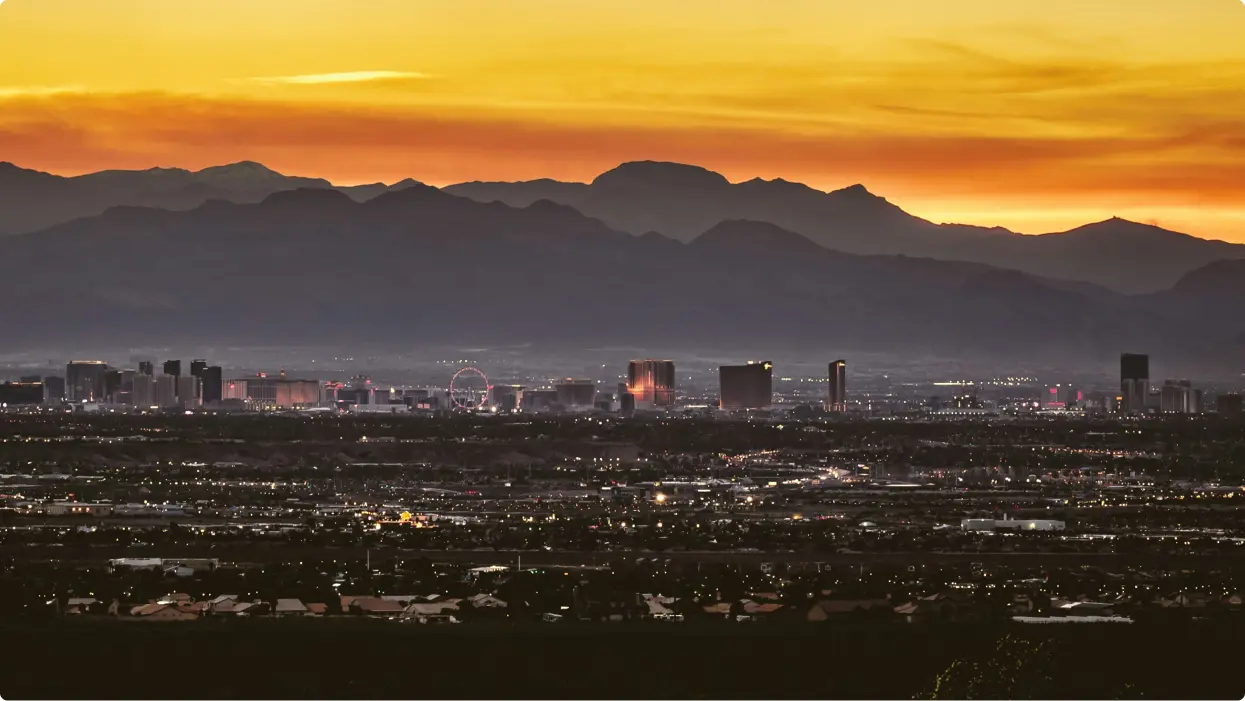

Las Vegas Valley at Dusk

Latest Updates

New RTC Projects Moving Forward

New Projects Moving Forward

See the latest transportation projects that Drive economic growth and improve visitor experience.

Community Workshops

Community Workshops

Join upcoming workshops to learn about the plan and share your feedback.

Interactive Map

Interactive Map

Explore transportation projects and investments happening across the valley.